
Salty Sam’s Fun Blog for Children
Number 564
St Francis of Assisi
Hello Everyone
l expect you are very busy in your house preparing for Christmas.
You may be staying at home for a traditional Christmas like we will be, or you may be planning to travel a long way away for a more exotic one.
You may also be preparing for a nativity play at school.
You may even be starring in it!
You may be a donkey or a shepherd, but l doubt you will be the baby Jesus in the crib otherwise you would not be old enough to be reading this blog post!
Bill and Bob said they were helping out with Christmas preparations by teaching Auntie Alice’s dog some tricks.
lt never ceases to amaze me how their minds work.
Anyway, Bill and Bob said that Sausage would be ready to show the whole family his new tricks as fantastic home entertainment when we all meet together at Christmas.
While l saw them working with Sausage, it gave me an idea for a subject for a blog post for you.
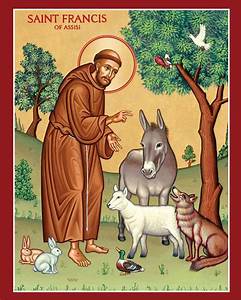
Francis of Assisi was a man who lived a long time ago who is very famous for loving animals and being very kind to them.
Let me tell you his story…
During the Mediaeval Era, Europe lived in times of much warfare.
Men were often called to fight for their king or prince or lord of the land.
One such man was Francis, a son of a wealthy, cloth merchant who lived in Assisi. This was a town in the centre of ltaly.
Francis was born in 1182 and his young life was comfortable and carefree.
His nature was a kind and peaceful one, and being a soldier did not really appeal to him. Neither did his father’s profession of being in trade. He was not interested in earning lots of money and becoming rich.
ln his late teens, Francis went into battle against the nearby town of Perugia, but was captured and put in a dungeon where he stayed for a year until his father paid the ransom needed to free him. Being in prison in those days was a terrible experience.
Following this, Francis had a serious illness, and then series of visions where he felt that God was speaking to him. He was convinced that he was being asked to follow a different sort of life.
So Francis left the army, gave all his money to the Church and left home.
His father was not pleased with him.
Francis was convinced that he had a calling in life – that meant that he was destined for bigger things.
He felt he needed to dedicate his life to serving the church. His first project was to repair a small stone church near his home.
He took a vow of poverty and went around the local district teaching the gospels. He began to have men follow him similar to the way the disciples had followed Jesus. By 1209 he had 11 followers. They came from many walks of life.
He started dressing in simple clothes; he dressed in a coarse woollen tunic tied at the waist with a cord, and used his band of men to help with his plans.
But he was told that he needed to ask the Pope for permission to form them into a religious order.
He walked with the 11 other men to Rome in the hope of gaining the Pope’s blessing.
He managed to see Pope lnnocent lll who was not very impressed by the sight of the dirty, scruffy men.
The Pope thought that Francis’ ideas and rules for his new order were too strict and restricting. He said that living in such extreme poverty as Francis wanted to, was not realistic, and such a life would not be appealing enough to attract men into his religious order.
But Francis insisted that his ways were similar to the way that Jesus lived, and it was how the gospels in the Bible indicated people should live.
ln the end, the Pope was persuaded to allow Francis to continue with his mission.
Francis returned to Assisi and his order grew into many hundreds of men.
They begged for alms (money and provisions) and grew their own food.
They continued to help anyone who needed it, especially people suffering from a terrible, disfiguring disease called leprosy, but Francis also had a special love for and connection with birds and animals to whom he showed great kindness.
Then in 1219, Francis decided to go to see the Sultan of Egypt in the hope he could convert him to Christianity to help end the Holy Wars in the Middle East. The plan did not entirely work.
Francis’ religious order spread all over Europe faster than any others before it.
There were monasteries in many different places.
ln 1224, Francis went to fast (go without food) on the mountain of Verna for 40 days. He went to live in a cave. Outside there was countryside and many wild animals and birds.
He lived in solitude and self-denial. ln Mediaeval times, very religious people thought to be without the comforts of life was a really good way to live.
There, he spent his time praying. He had more mystical visions and it was reported he had wounds appear upon his body similar to those Christ received during his crucifixion.
Then his health began to fail.
Monks cared for him until his death in 1226.
He was declared a saint by the Catholic Church only two years after his death, and remains one of the most famous saints. Saint Francis Feast Day is on 4th October when animals are often blessed in special ceremonies and Saint Francis of Assisi was declared the patron saint of ltaly.
He had established the Franciscan order of friars and the women’s Order of the Poor Ladies (at the request of a woman he knew called Clare of Assisi).
Also, the Third order of Saint Francis for men and women who wanted to live by the principles of the Franciscan Order without leaving their daily lives and jobs to live in a monastery or convent. This is called a secular order.
Secular means not of the church.
There are still Franciscan monks today living in monasteries wearing simple tunics called habits.
Francis is also famous for setting up the first known Nativity scene as a focal point to celebrate Christmas in 1223.
lt had real animals in it.
Bye bye everyone – don’t forget to subscribe to my blog!
Love and kisses
Salty Sam

www.christina-sinclair.com

Bill and Bob’s Joke of the Week
Bill: Why are you turning the television on Bob?
Bob: l want to see this programme. They are going to teach you how to age denim clothes.
Television Announcer: The following programme contains distressing scenes.
Salty Sam © Christina Sinclair 2015
Unauthorized use and/or duplication of material from this blog without express and written permission from this blog’s author and owner is strictly prohibited.
Links may be used to www.christina-sinclair.com

Picture Gallery

PAX ET BONUM = PEACE AND GOOD

The Poor Clares
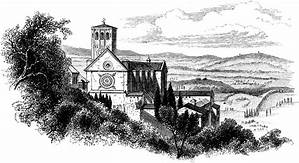
Assisi

Franciscan monks still wear robes tied at the waist
 THE SALTY SAM NEWS DESK

Well, the children at the Rocky Bay Primary School have had quite a week.
The vicar arranges for a group of carol singers to wander around town one evening at this time of year to collect money for the upkeep of the Rocky Bay Village Hall and the activities that go on there. It is a place that services the whole community.
Miss Pringle wanted to get her children to sing carols too, and the vicar suggested that if any children from the school wanted to join our happy throng, they would be welcome.
So one afternoon, the children in Miss Pringle’s class who wanted to go carol singing stayed behind. They had brought some extra food in their lunch boxes and Miss Pringle had brought them in some cakes to make sure they were well stoked up to face the cold, winter night. What a lovely treat!
She also made them some hot drinks in the staff room before they set off on their way, and brought them in to the classroom on a tray.

In the past, the carol singers used to meet up in the Rusty Anchor Inn situated on the harbour wall; but this year we all went to the playground at the school instead.
When the children came out to meet us they were in for a wonderful surprise.
There were some reindeer in the playground!
Yes really!
There were two real reindeer outside waiting for them.
A keeper had brought them to the school from the Rocky Bay Animal World at the Rocky Bay Theme Park as I had arranged.
They were pulling a small sleigh that Captain Jack and I had made and covered with fairy lights. The sleigh was on wheels rather than runners because after all, you can’t rely on the weather to provide us with snow in Rocky Bay at this time of year.
The children were amazed – and of course thrilled.
Henry usually takes the bucket we collect money in around on his little toy wagon and he was a little disappointed that he was told that he would not be doing it this year.
But when he saw why, he was as happy and excited as everyone else.

So once the vicar and his wife had turned up with the song sheets, we sang our way around the town; all in good voice.
We also collected more money than we ever had before.
People loved stroking the reindeer before they threw some money into the bucket that was behind them on the sleigh.
I do have some really brilliant ideas sometimes!
We tried to cover as much of town as we could and walked round in a big circle until we got back to the school.
I think the children will take with them very happy memories of that evening.

Then they went home with their parents, most of whom came carolling with the group; because by the time we had finished it was getting on for bed time – for the children and the reindeer!
And then the rest of us went to the vicarage for hot drinks and mince pies.

*********************
*********************
 Quick Quiz
Some place names in Britain can also be found in Canada.
Can you un-muddle these letters to work out what these place names are?
- nodlon
- threeproobug
- phert
- wrollcan
- snonkgit
- madcribg
- brugexid


lt’s the Weekend!

HOW TO MAKE KNTTED TREE BAUBLES
This week, we have another pattern for Christmas decorations for you.
You can put any colour you like in the centre band and you can also choose which way up you would like to hang these baubles because there is a pattern created across the knitting when you change back to white yarn. You can choose where it goes.
These decorations match in with all the knitted socks and snowmen, etc, you can find on other blog posts.
If you decide that you want to have very unusual coloured decorations like pink and purple, making your own decorations like this can make it happen.
BAUBLE (KNIT ONE)
Using 4mm knitting needles and white dk yarn cast on 23 stitches leaving a length of yarn at the beginning of the knitting to run around the base of the bauble to pull the knitting in at the bottom later
Knit 6 rows of moss stitch
Change to red or green dk yarn
Knit 4 rows of stocking stitch
Change back to white
Moss stitch 6 rows
Don’t cast off
Cut your yarn off and thread the end through your stitches
(Moss stitch is slip 1, (knit 1, purl 1) repeat the last 2 stitches to the end of the row)
TO MAKE UP
- Pull the stitches at the top in tight and then sew down the back of the bauble using over-sew stitching with right rides together
- Secure a length of white yarn into the seam or use the yarn you left to work with when you started knitting and then thread it through the bottom of the knitting using running stitch
- turn the bauble the right way out
- Stuff the bauble and pull the bottom in tightly
- Then secure all ends and neaten
- Cut of some dark green or black thread 30cm long and sew through the bauble from top then back down to the bottom (don’t go into the same hole at the bottom)
- Knot the two ends of thread at the bottom of the bauble
The bauble should look like it is floating in the air below the branches of your tree if you use dark thread to make hanging loops.

Please note that the material on this blog is for personal use and for use in classrooms only.
It is a copyright infringement and, therefore, illegal under international law to sell items made with these patterns.
Use of the toys and projects is at your own risk.
©Christina Sinclair Designs 2015
Quick Quiz Answers
- nodlon – London
- threeproobug – Peterborough
- phert – Perth
- wrollcan – Cornwall
- snonkgit – Kingston
- madcribg – Cambridge
- brugexid – Uxbridge