
Salty Sam’s Fun Blog for Children
Number 565
The Scot’s Pine
Hello Everyone

Bill and Bob are always on the lookout for tree seeds to grow.
Some are easier to spot than others.
lf you want to get seeds out of pinecones, you will only be able to do it whilst they are dry. lf they are wet, they close up tight and you won’t be able to get in!
Bill and Bob found some seeds hiding in some pinecones. The seeds look like brown paper. These are only released on dry days so that the wind can blow them through the air; so this is why when the weather is damp, the pinecones close up.
The Scots pine as the name suggests comes from Scotland and is its national tree. lt is the only truly native pine tree in the British lles.
Pine trees and other evergreen trees and shrubs are more noticeable this time of year because they are the only green trees around.
lt is grown for timber to be used in the building industry; it is dense and strong.
lt is one of the native trees found in the ancient Caledonian Forest. They can grow up to 20m tall. The seedling look like little bristles, because they have needle-like leaves; so look different from other seedlings.
These trees are monoecious, so the male and female flowers grow on the same tree. They use the wind to pollinate their flowers. The clouds of pollen can blow up to one hundred miles away to fertilize flowers!
These flowers will turn into pinecones which contain seeds.
These seeds will also blow away in the wind and grow into a new tree.
Scot’s pine trees were very valued by the druids. They would decorate them with lights in midwinter to celebrate the return of the sun as the days began to lengthen at midwinter solstice.
(Nowadays, when we do this, we use smaller trees because we like to bring them indoors in order to decorate our homes.)
Scots pines are trees with a very long life, many hundreds of years, and are found from the Arctic Circle to the south of Spain, across Europe and around the Mediterranean.
You have probably noticed them if you have been on holiday near the Mediterranean.
These trees were introduced to America in about 1600, and were widely planted in New Zealand as well. They are the world’s most widespread conifer.
ln Scotland, some trees are thought to mark grave sites of ancient Scottish chieftains and soldiers, and some lone trees signpost important routes and track ways.
Pine resin can be used to ease lung congestion; it has a nice smell.
Pine trees, just like other trees, are very aware of what is happening to them, and what is happening in their environment and to other trees around them.
lf they are being attacked by insects like aphids (greenfly) that want to eat their leaves, they send out a cloud of invisible chemicals which have a kind of perfume that attracts the kind of insects like ladybirds that will eat the aphids.
The predators are glad to know where they can find some lunch and swarm in to rescue the tree!
And Bill and Bob continue to grow tree seeds to try and help rescue the Earth!
ln the meantime, we are all going round to Auntie Alice’s house to help her with her decorations. She likes to put them inside her cottage and outside in the garden as well – that means l will be up a ladder again.
l expect you are busy making lots of decorations and putting them up at school and at home too.
There is so much to do around this time of year isn’t there!
Bye bye everyone – don’t forget to subscribe to my blog!
Love and kisses
Salty Sam

www.christina-sinclair.com

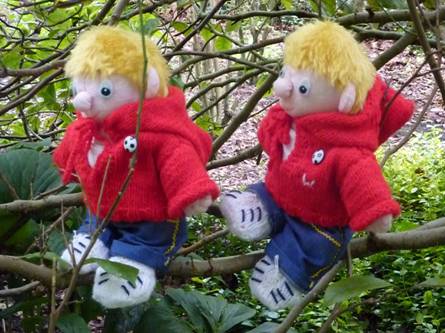
Bill and Bob’s Joke of the Week
Bill: Why was the pine tree always in trouble?
Bob: Well. l don’t know. Why was the pine tree in trouble?
Bill: Because it was so knotty!
Bob: l think the tree seeds we planted are doing tree-mendously well Bob.
Bill: Well, that’s a re-leaf!
Bill and Bob’s dad: Just don’t water them with root beer!
Bill: That is acorn-y joke Dad!
Salty Sam © Christina Sinclair 2015
Unauthorized use and/or duplication of material from this blog without express and written permission from this blog’s author and owner is strictly prohibited.
Links may be used to www.christina-sinclair.com

Picture Gallery

The horizontal branches of the Scots pine


 THE SALTY SAM NEWS DESK

Bill and Bob have been getting on well with their dog training efforts this week.
Henry and Emily have been helping.
They say that Sausage would be ready to show the whole family his new tricks as fantastic home entertainment when we all meet together at Christmas.
We should prepare ourselves to be amazed.

Anyway, while they were busy with that and out from Auntie Alice’s feet as it were, she was able to get on with doing some cooking and the children settled down to write their questions for their team to ask at the Friday afternoon quiz at school.
They are hoping for snow this Christmas, like all children probably, and so they had weather on their minds and used it as a theme for their quiz.
Can you answer their questions?
- Which comes first, thunder or lightning?
- What is the difference between muggy and raw?
- What is precipitation?
- Which is thicker, mist or fog?
- What is slush?
- How many sides has a snowflake?
- What temperature does water freeze at?
- What does a red sky at night mean?
- Are cirrus clouds high or low clouds?
- What instrument measures air pressure?


*********************
*********************
 Quick Quiz
Can you un-muddle these letters to find ice cream flavours?
- navlila
- roang
- blubumbg
- thaclooce
- focefe
- spapryrrbirple
- siphitaco


lt’s the Weekend!

HOW TO MAKE A BOBBLE GARLAND
Since Emily found out how to make little, yarn bobbles on the prongs of a fork, she has made piles of them.

Then she has strung them onto strings of yarn to make garlands.
These garlands can be made with many colours or maybe in just red, green and white so they can be used for Christmas.
They can be made out of rainbow yarn.
Of course they can be used for birthday parties and garden parties too – because unlike paper, they will not dissolve in the rain.
When they are packed away they don’t get squashed and crumpled.
These garlands can be strung between trees or around a Christmas tree.
They can be strung across walls or across rooms.
They can be made in a particular colour to mix in with an unusual colour scheme that a room is decorated in.
And here is another idea…
If you have tiny toys or plaques or too many ornaments for your tree, you may want to make them into garlands too so that they can be on display.
If you haven’t got enough of those to fill a whole length of yarn to go across your wall, you can cut some shapes out of felt to mix in with them.

Please note that the material on this blog is for personal use and for use in classrooms only.
It is a copyright infringement and, therefore, illegal under international law to sell items made with these patterns.
Use of the toys and projects is at your own risk.
©Christina Sinclair Designs 2015
Answers to the News Desk Quiz
- Which comes first, thunder or lightning? – lightning
- What is the difference between muggy and raw? – muggy is humid and warm, raw is humid and cold
- What is precipitation? – rain
- Which is thicker, mist or fog? – fog
- What is slush? – melting ice
- How many sides has a snowflake? – six
- What temperature does water freeze at? – zero degrees Celsius
- What does a red sky at night mean? – fair weather the next day
- Are cirrus clouds high or low clouds? – high ice crystals
- What instrument measures air pressure? – a barometer

Cirrus clouds

A barometer
Quick Quiz Answers
- navlila – vanilla
- roaneg – orange
- blubumbeg – bubblegum
- thaclooce – chocolate
- focefe – coffee
- spapryrerbirple – raspberry ripple
- siphitaco – pistachio