
Salty Sam’s Fun Blog for Children
Number 573
The Fastnet Lighthouse
Hello Everyone

Welcome to the eleventh anniversary of my blog!!!

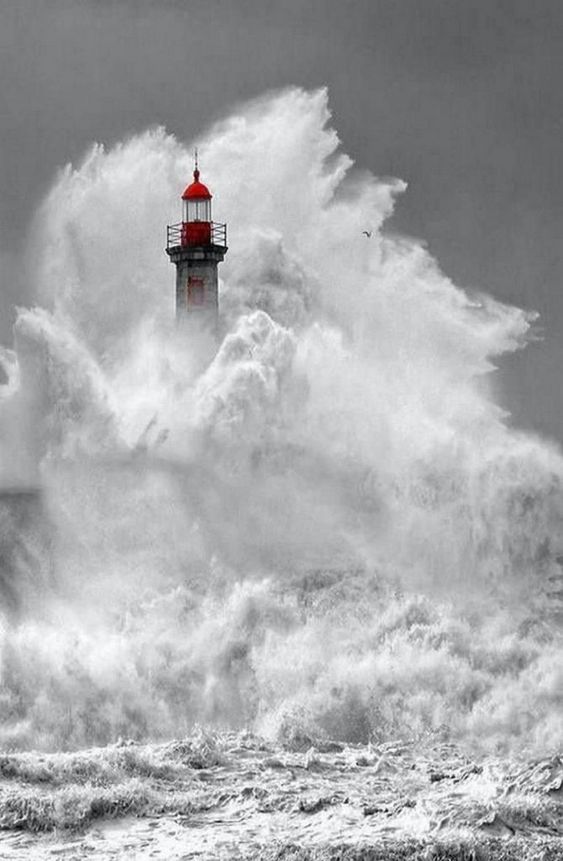
l have been sitting here tapping away at my keyboard writing my blog post this week with the winter storms lashing around my lighthouse home and enormous waves pounding its walls.
l am sitting way out here in the middle of the sea with Rocky Bay just in sight through the murk, and the Atlantic stretching out to the west outside my windows.
As you know the Atlantic Ocean is one of the most dangerous waters in the world – it can be very tempestuous!
Living in a home like this is not for the faint-hearted, l can tell you. And building lighthouses was an even braver feat of daring and courage.
So what better topic for me to choose for this week than a subject close to my heart, but lighthouses – and this week l want to tell you the story about a very famous lighthouse with a very interesting history.
You may know the name Fastnet from a famous yacht race, which has hundreds of competitors who use the Fastnet lighthouse as a turning point as they travel from Cowes on the lsle of Wight to the race finishing line at Plymouth.
Or you might know the name as a sea area mentioned on the Shipping Forecast issued by the Met (short for metrological) Office on behalf of the Maritime and Coastguard Agency broadcasted on BBC Radio 4.
This is the longest running continuous forecast in the world, and very useful to all sailors and anyone who has a job connected to the sea.
But anyway back to my story…
The Fastnet lighthouse is built into a hulk of a rock 8 miles off the south coast of lreland – the mainland of County Cork to be exact.
The rock stands high and proud above the water with the coast way off and just about in sight.
ln Norse the rock is called Sharp Tooth lsle and in Gaelic, Lonely Rock.
And it is a lonely rock.
This outcrop was always a wonderful sight for home-comers knowing they were nearing port; but sadder for those who left their motherland probably forever as they fled famine and poverty during mass migration after potato blight destroyed the staple (main) food of most of the population in 1847.
The Fastnet rock was from that point, dubbed lreland’s teardrop.
And 3,000 miles to the west lay New York; the gateway to the emigrants’ new life.
The southern coast of lreland is jagged and dangerous, and from olden times, claimed many ships that were doomed to be wrecked on the rocky outcrops jutting out from the shoreline.
As early as the 5th century, people started lighting large fires to mark the coastline’s bays to safely guide in ships.
And lights have been kept in this place in all the centuries that followed.
ln the 19th, century, many lighthouses were built all around the lrish coast as guides for shipping. They mark dangerous places and places of safe harbour. They are marked on nautical (sea) charts so sailors know where to look out for them.
ln 1848, after the loss of an American packet ship the Stephen Whitney in December of the previous year, it was decided to build a lighthouse on the rock at the most southerly point of lreland to help guide trans-Atlantic shipping. There was a lot of money involved in trade with the Americas so the investment was thought worth-while.
The Cape Clear Lighthouse was often shrouded in mist. The mist would block the light and so another lighthouse was needed to replace it.
The Fastnet lighthouse is known as a rock lighthouse because it is built on a rock out to sea rather than on the mainland. My lighthouse home is a rock lighthouse.
George Halpin designed the new Fastnet lighthouse to be constructed from brick with an iron cladding. lron was the fashionable building material of the day. lt was used to build bridges, ships and even the very attractive Eiffel Tower built for a World’s Fair.
The new lighthouse was 28m (or 91 feet) tall and had an oil-burning lamp.
The Fastnet lighthouse was completed at the beginning of 1854, but when a ferocious storm hit the coast of lreland on 26th November 1881, the lantern was smashed and the lens damaged.
A nearby lighthouse, on Calf Rock off the southern entrance to Bantry Bay which was constructed in a similar way was snapped in two.
With the top half of the lighthouse missing, the six terrified keepers managed to survive for twelve days before the storm abated enough for them to be rescued. We lighthouse keepers are indeed brave men! l just thought l would toot my own trumpet for a moment there.
Anyway, back to my story…
The lighthouse authorities did not want the same thing to happen to the Fastnet Lighthouse, and so they decided a new lighthouse should be built as a replacement.
The designer William Douglass would build it in stone. The local stone would not be strong enough though, and so in 1897 they started importing granite, a very tough stone, from Cornwall in the south west part of England.
The blocks of granite were cut into particular shapes and then put together more like jigsaw puzzle pieces than rectangular bricks lined up on top of each other like you would see in an ordinary wall.
The process is called dovetailing, and was taken from a method of fitting together joints in carpentry (making things out of wood).
This process made the walls very strong, and then they could withstand the force of huge sea waves hitting them.
But the construction also has give in it – like a tree sways in a gale.
This is so that it will not crack and snap.
The lighthouse can sway up to 2 metres at the top as it is pounded by waves and blasted by strong winds. This process is called ‘give’. A stretchy, knitted sweater has more give in it than a rigid pair of denim jeans, for example.
This ability to move gives the lighthouse a better chance of not collapsing.
But working with masses of stone on a small island was a huge challenge. lt was difficult and dangerous.
The builders worked from meticulously, (very carefully) hand-drawn blueprints.
They worked through any weather that nature could throw at them be it: blasting winds, freezing cold, driving rain or fog – and high waves could crash over the rock drenching them in salt water.
Miraculously there were no fatalities during the construction, which was an unusual and good outcome for the times.
James Kavenagh the foreman who managed the project personally set all the 2,047 blocks into place by hand – with the help of cranes to manoeuvre them into position.
He was a dapper man who always stood out in the working gang because of the pristine, white jacket he wore.
He was totally dedicated to his job and stayed on the rock for seven years overseeing the project, sleeping in a cave overnight that is now known as Kavenagh’s Hole.
ln fact, he refused to leave the rock at all, all the time there was work going on.
Kavenagh left the island in June 1903, but sadly died a month later and never saw the lantern lit.
The light was imported from Birmingham in England, but was damaged in a storm while being installed. The explosive fog signal was transferred from the old tower, and an electric horn was installed in 1974.
The 1854 tower was dismantled, and the ground floor room was left to be used as an oil store.
The new Fastnet Lighthouse started functioning in June 1904 and still stands today as the tallest lighthouse in the British lsles.
The lighthouse was automated in 1989, and although there are no lighthouse keepers living there anymore, the tower is still maintained to be in good working condition by lrish Lights – the authority that looks after all the lrish lighthouses.
These old lighthouses are a monument to the men who built them.
They were incredible feats of engineering and a testament to the huge efforts of the workmen who worked under the most difficult of conditions. They had vision, ingenuity, skill, resilience and perseverance.
Lighthouses are very important visual aids to shipping even today, and will be for many years to come.
Bye bye everyone – don’t forget to subscribe to my blog!
Love and kisses
Salty Sam

www.christina-sinclair.com

Bill and Bob’s Joke of the Week
Bob: Who is the meanest fish in the sea?
Bill: The Codfather

Salty Sam © Christina Sinclair 2015
Unauthorized use and/or duplication of material from this blog without express and written permission from this blog’s author and owner is strictly prohibited.
Links may be used to www.christina-sinclair.com

Picture Gallery

Shipping areas

Fastnet race

Fastnet

Construction of stone blocks seen from above

James Kavanagh remembered on a plaque
Lighthouses need to withstand turbulent weather
 THE SALTY SAM NEWS DESK

This week, Miss Pringle told her class about a very interesting experiment she had heard about.
Apparently, some scientists discovered that a certain group of prisoners had very limited vocabulary and decided to set out to teach them a lot of new words.
The results of the experiment showed that the more words the prisoners knew, the better-behaved they became!
(And of course, they had ended up in prison in the first place because they hadn’t been well-behaved!)

If you have a large knowledge of words, you can better understand what is being said to you, and better express your thoughts and feelings.
The more words you know, the better you can formulate (create) thoughts in your head and impress others with them.
So then Miss Pringle decided to check up on how the children’s new word books were coming on.
They all had a notebook where they put the new words that they came across.
The new word was put in a column on the left side of the page and the meaning was put in the column on the right. The right column was slightly wider.
Sometimes, the children put a sample sentence containing the word into the right column as well.
The pages were soon covered with new knowledge.
Miss Pringle had found that some of the children had made a good effort, and some had not done so well.
Two children said that they had left their books at home. They said that they had been adding words from books that they had been reading at bedtime.
Miss Pringle said she would look at them the next day.
These are some of the words the children had collected.
Do you know what they mean?
- Harrowing
- Punctual
- Coy
- Momentary
- Indignant
- Ceaseless
- Jurisdiction
- Ascend
- Audible
- Flourish
- Nocturnal
- Murky


*********************
*********************
 Quick Quiz
Sometimes words and phrases do not have literal (straight forward) meanings; they are idiomatic. You cannot understand them from using a normal dictionary.
You definitely can’t translate them into other languages, well not usually anyway.
Do you know what these words, phrases and idioms mean?
- a new dawn
- a hand up
- storm clouds are gathering
- undermined
- the winds of change
- by my own hand
- owning your mistakes
- to hit the jackpot
- waiting for your ship to come in
- sitting pretty


lt’s the Weekend!

HOW TO MAKE A SEED FlLE
If you have your own vegetable plot, and you have lots of seeds you want to plant, it might get quite confusing when you have to decide when you have to plant them.
If you buy a packet of seeds, there will be instructions on the pack telling you when to sow them.
If you live in the far south, the far north or somewhere in between you will have to judge whether you can sow seeds early or have to wait a while for your soil to start warming up.
If you use seed trays to start your seedlings off, they will get a good start inside while they are young and tender.
If you use succession sowing – that means sowing a third or a quarter of the pack at a time at weekly intervals, your harvest will not come all at once; you will be able to stagger it across the summer.
This is a clever plan to have.
To get you organized, you can use a seed file.
Firstly, find a box like a shoe box and cut some cards to use as file cards- they will be as tall as the sides of the box.
Make a plan for your vegetable plot and decide what you want to grow and where you want to plant your crops.

Don’t be over-ambitious – plants don’t want to be too crowded, they need room to grow and you may need room to put cloches or netting over them to protect them from birds or insects.
Also don’t forget from year to year you should rotate your vegetable crops to keep your plot healthy. That means grow new crops in a different place from before. You could use a three-year plan or a four-year plan.
You don’t need to worry about this with fruit like raspberries or gooseberries or annual flowers.


Draw out your vegetable plot plan so it looks like a map, and put dates inside the boxes/sections – your sowing dates.
Put your plan at the front or in the front of your box – don’t lose it! You will need to refer to it next year.
Put dates on the top of the cards – like every Saturday over the sowing period. That could be as long as from February to May depending on what you want to grow and where you live.
Your file will look like the drawer from a filing cabinet.

Or you could even use a little chest of drawers to keep your seeds in.
But remember that it is really important that seeds must be completely dry when they are stored. A lot of seeds don’t store well from year to year, so if you want to keep some for next year, check to see if they will store well.
Put your packets into the first section you will need them and move the packet onto the next week once some of the seeds have been used.

Or you could maybe find an old homework or housework caddy to use.
Fold down the top of the packets and put a couple of paper clips or a bulldog clip on the folds so that you keep them as air-tight as possible.
If you can use a plastic of metal box for creating your seed file the seeds will be kept in an even more air-tight condition.
If you can’t find a box, then you can find a file and put your plans, diary and seed packets in plastic pages.
You may want to start a file for fruit, one for vegetables and one for flowers if you have stretched yourself far and wide in your garden!

Please note that the material on this blog is for personal use and for use in classrooms only.
It is a copyright infringement and, therefore, illegal under international law to sell items made with these patterns.
Use of the toys and projects is at your own risk.
©Christina Sinclair Designs 2015
Answers to the News Desk Quiz
- Harrowing – distressing, upsetting
- Punctual – arriving on time
- Coy – shy
- Momentary – quick, short-lived
- Indignant – annoyed, disgusted
- Ceaseless – constant
- Jurisdiction – authority, in charge
- Ascend – go upwards
- Audible – can be heard
- Flourish – be successful, to grow
- Nocturnal – relating to the night
- Murky – foggy, unclear
Do you make a record of the new words you learn at school?

Quick Quiz Answers
- a new dawn – a new beginning in life – it could be for a person or an industry or a country or the world, for example
- a hand up – being helped into a better position
- storm clouds are gathering – problems seem to be on their way – like if you see that war is going to break out somewhere
- undermined – if you built a mine right under a building, it would probably collapse because its foundations would be badly affected – so if you cause someone problems by attacking them somehow, you would affect their stability too – you could say bad things about them to ruin their reputation, or you could take away the authority they once had, for example
- the winds of change – feeling that there are things happening that will change life for you or a group of people
- by my own hand – making something happen by your own efforts
- owning your mistakes – saying that you made a mistake and you want to put things right
- to hit the jackpot – become successful quite quickly
- waiting for your ship to come in – hoping that an investment you made will bring good returns – like people who used to fund an overseas expedition which would hopefully bring back goods to sell – these were brought back by ship and the ship would arrive back at whatever time the weather and the fates would allow
- sitting pretty – being in a comfortable position – maybe you have a lot of money or good fortune or a comfortable life

Thank you for the good writeup. It in fact
was a amusement account it. Look advanced to more added agreeable from you!
However, how could we communicate?
Thank you very much AW.