
Salty Sam’s Fun Blog for Children
Number 578
Servants
Hello Everyone

lf l was to guess who the richest person is in Rocky Bay, l would say that it has to be Zig Zagger the retired pop star who lives in a mansion at the back of town.
He has a swimming pool and a Rolls-Royce car.
He has a cleaning lady that keeps his mansion nice and clean and tidy, a gardener that keeps the garden looking nice and sometimes when he has parties he hires a private chef. The front gates of his mansion open electronically when he pushes a button.
None of these people live in the house with him. They just visit to do their jobs.
Some people do have servants living in their house all the time; although nowadays they are called staff rather than servants. They might be personal assistants that organize things and do paperwork, they might be a chauffeur and gardener, or a butler who serves at table, brings the mail in on a silver platter and organizes the household affairs.
Throughout history, people have had servants to look after them and their property. lf you do an important job, like looking after the affairs of government, it is enormously helpful to you to not have to worry about buying food and weeding the garden as well!
Back in Ancient Greece and Ancient Rome, some of the servants were actually slaves. They were not free people; they were owned by their masters.
From then on affluent (rich) people have always had servants around in attendance. ln mediaeval times, they could have slept under the master’s bed to be in close attendance; female domestic servants were rare in those days.
ln Georgian times, they could have slept across the front door as a kind of burglar alarm. You could not just phone up the police when you were in trouble like you can nowadays. There weren’t any police like we have today.
ln Victorian times, some people had enormous houses full of people bustling around doing lots of jobs that had to be done. And some people could live in more modest abodes with just a maid and a cook.
Male servants had more status than female ones. They would have the more visible jobs of answering the front door, serving food at table and travelling on the back of a carriage or in the front of a car with the family when they left the house.
ln a big house, the front door had a bell on a cord that rang in the servants’ hall, so that someone would know the front door needed answering. There were bell pulls or buttons in every room so that servants could be summoned.
Each bell that rang downstairs had a label so that the servants would know which room to go to. Each bell also had a different sound so that if the servants could not read, or nobody was looking at the bells when one rang because they were busy, they would still know which room to go to. They got to recognise the different sounds.
A servant could be called to do even a menial task or go away again to fetch something like refreshments. lt is said that the Queen Mother never drew a pair of curtain in her life – the servants always opened and closed the curtains.
Everything was carried in an elegant way: on trays or draped carefully over an arm.
The servant in charge of the household and the servants would be the butler.
He would control the household budget and keep the keys to all the stores.
He would know about wines and which type of wine would be served with which kind of food. White wines had to be served chilled and red wines would be left open for a while before they were served. This was called leaving the wine to breathe – it improved the taste of the wine.
Bottles of wine, port, brandy and liqueurs could be very expensive and needed to be locked away for safe-keeping. Port, brandy and liqueurs were served at the end of a meal.
The servants directly under the butler would be footmen. They could serve at table and travel on carriages – just like in the Cinderella story.
Female servants would be working under a female servant who was maybe called a housekeeper. She would look after their welfare. A housekeeper might look after the food and household linen stores too.
The senior female servants would have the title of Mrs even if they had never married. lf a female servant got married, they often left service and were then kept by their husband – that means they husband paid all the bills and she became a housewife. Before the 1960s, when a woman got married she often left work to start a family and stay at home with her children. Married women often did not go out to work.
The cook in a household was often a woman and she would have been afforded some status and respect. She would take responsibility for creating menus, ordering food stores and managing kitchen staff. Learning to be a competent cook would take a lot of training.
Lots of orphans were put into service at a young age. The community of servants would then become their family. They could stay in a household in the employ of a particular family for the rest of their life. They had somewhere to belong. (This doesn’t mean to say that they could not get married and have their own family when they grew up; or even leave service and go to work in a shop or office or on farm, for example.)
Of course, when they had some experience, they could be promoted or apply for another position in another household if they wanted to. But they would always start off in a lowly position.
The lowest position for girls was scullery maid. The scullery maid would work in the scullery which was a little room off the kitchen that had a stone floor and a large sink in it. The scullery maid would wash the plates, dishes and cutlery and scrub the pots and pans. She would also do lots of cleaning jobs around the house like scrubbing the kitchen table tops and floors and beating the carpets and rugs to get the dust out of them.
She would assist the kitchen maids by scrubbing vegetables and cleaning fish. She would do lowly, boring, repetitive jobs like churning butter and plucking any fowl brought in from the local farm before they could be roasted. She would eat in the kitchen and keep an eye on the food cooking on the stove, not in the servants’ hall with the other servants.
She would get up earlier than anyone and lay the fires in the fireplaces around the house so that the rooms would be warm when the family got up for breakfast. Before indoor plumbing she would heat up water and carry it up to the bedrooms so that it could be used for washing or bathing.
She wore poor clothes rather than the crisp, smart uniforms that the housemaids wore.
The housemaids would wear a lighter-coloured dress and a white apron during the daytime and a black dress with a white apron in the evenings.
The family would dress for dinner – that means that they would put on evening dress. The women would wear evening dresses and the men would wear formal, dark suits.
The women of the family could have their own maid called a lady’s maid. This maid helped dress the lady – she would need help if her outfit needed to be laced together like in Tudor times or a corset needed to be laced up like in Victorian times. That is why women’s clothes do up in the opposite way to men’s. Men usually could dress themselves, but women were dressed by other people.
A lady’s maid would be in charge of maintaining a lady’s wardrobe. She would do any mending that was necessary, do hand-washing and ironing. She would choose clothes for her lady to wear; see to the storing of them and pack suitcases for trips away. She would help her lady choose jewellery and accessories to match with outfits. She would be her hairdresser. She could go shopping for her to buy things like perfume or new gloves. You might even read books to them in order to entertain them and be company for them.
The servant who looked after a man’s wardrobe of clothes was called a valet.
lf you were a lady’s maid or a valet, you may talk to the member of the family you were looking after in a more personal way than the other servants and you would be expected at all times to keep their secrets! Discretion was very important.
Some families called their servants by their surnames and some called their servants by their first names. But in some households, more senior servants were called by their surnames and the more junior ones were called by their first names.
There were lots of servants outside too.
Lots of gardeners tended to the gardens and vegetable gardens and orchards. They brought freshly picked fruit and vegetables to the back kitchen door. They would provide fresh flowers for the house as well for the maids to put in vases to decorate the rooms. They would mow the lawns for the family to walk on.
lf you ever see a farm with the name ‘Home Farm’, it was probably a farm that belonged to a grand house. This farm would provide a range of food for its large household.
The family would eat grander food than the servants; they had a plainer diet.
Then there were all of the servants that looked after the horses, and later in history, the cars that the family owned. Servants could start work in their early teens as a stable lad, an under gardener or a boot boy.
A boot boy, sometimes called boots, was a low-ranking servant who cleaned the shoes and boots of the household and did other menial tasks that needed doing.
He could have also been a hall boy who slept in the servants’ hall and served the servants’ meals.
He was the lowest male servant on a par with the scullery maid who was the lowest female servant. These were the servants that carried out any chamber pots that had to be emptied in the morning. Chamber pots were used before flush toilets were in common use and were kept under the bed in case they were needed in the night.
Only maids and footmen were entrusted to clean fine chinaware and polish the valuable silverware like cutlery and candlesticks.
And of course, there were servants that were especially employed to look after children too. Nannies looked after babies and tiny children.
ln the last few decades, they were often especially trained and qualified at a special college to do this job, but before that, they could have been a woman who had just had a baby and so looked after their baby and the baby of someone else at the same time. She was called a nurse, and of course we use that word for a different kind of job nowadays.
When the children were of school age they were sent away to boarding school or educated at home by a governess who taught them many subjects in a school room in the house. Queen Elizabeth ll didn’t go to school; she was educated at home with her sister Margaret-Rose.
Servants worked long hours – up to maybe 16 hours a day. They were up before the family to prepare the house for them, and went to bed after them to tidy up and lock up the house. They went to bed especially late, if the family went to the theatre or a party.
They worked seven days a week and only had a day or evening off for recreation occasionally. Traditionally, Boxing Day was the day the servants received presents from the family that employed them, and had a day off to visit their own real family, if they had one that lived locally.
The rooms that the servants did most of their work in were ‘below stairs’ – or in other words, in the basement. Here would be the kitchen, scullery, servants’ dining room and cloakroom, shoe cleaning room, store rooms and offices of the most senior servants. The servants usually used back staircases to keep out of sight as much as possible when they needed to move around the house.
The servants usually slept in the attic rooms, which could be very cold. Young maids might huddle together under the covers in the same bed to try and keep warm on cold, winter nights. They did not have many clothes or possessions. They may have had just one best dress or outfit.
The senior servants had a bedroom to themselves, but the junior ones often had to share.
lf servants married each other and continued working for the family, they were often assigned a small house on the estate and so did not have a bedroom in the attic anymore.
Large houses full of servants started to become a thing of the past after the First World War.
Lots of men had died in the trenches, families had lost fortunes, and people could earn more money working in shops and offices than in service, and then go home for the evening to their own homes.
Also, most importantly, machines and gadgets were being invented that would mean intensive labour was less necessary. ln other words, a machine like a tractor, could do the work of many men. Kitchen gadgets took work away from kitchen maids.
After the Second World War, every week, huge stately homes were being torn down and large estates were being parcelled up and sold off.
The Royal Family employs lots of servants nowadays. All of them have very specific jobs. Some might just look after the horses in the Royal Mews and others might be employed to look after the valuable clocks around the palaces or open personal correspondence (letters).
Not many families in this country nowadays have huge numbers of servants anymore.
Bye bye everyone – don’t forget to subscribe to my blog!
Love and kisses
Salty Sam

www.christina-sinclair.com

Bill and Bob’s Joke of the Week
Bob: Look Bill! We have just had a text from Auntie Alice. l think she wants us to go round to her cottage.
Bill: What did she say?
Bob: N E 1 4 T?
Salty Sam © Christina Sinclair 2015
Unauthorized use and/or duplication of material from this blog without express and written permission from this blog’s author and owner is strictly prohibited.
Links may be used to www.christina-sinclair.com
Picture Gallery

Chamber pot


Carpets were hung over a line and beaten with a carpet beater

Victorian servants
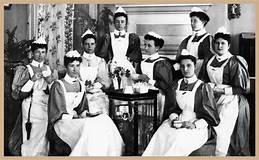
Maids in their caps and aprons

A large kitchen

An attic bedroom
 THE SALTY SAM NEWS DESK

Funnily enough Bill and Bob ran into Zig Zagger this week.
He had popped into a shop in Rocky Bay to buy himself a chocolate bar and they met him in there.

He told them that his gardener was clearing out some old, dead bushes in his garden and he was getting fed up with all the loud noise so he had gone out for a while to get away from it.
Bill and Bob thought it strange that a rock musician didn’t like loud noise, but they didn’t say anything.
Zig said that he didn’t know what he was going to put in their place, but he was fed up with looking at the scruffy mess that the gardener was in the process of clearing up.
Bill and Bob, always on the hunt for a home for the trees that they are always growing from seed, asked him if he had considered putting part of his garden over to natural woodland.

He thought it was a good idea and invited Bill and Bob to bring round some of their pots and he would give them tea.
They felt very honoured to be invited to his mansion. I went with them to help out. In the end, I helped myself to a few cream cakes while I was there.
Yum! Yum!

Anyway, they found a home for their trees in a far corner of Zig’s garden, had a nice slap up tea and came home with some extra pocket money too!
They didn’t ask for any money, but Zig insisted he paid them for all the young trees they had brought.
They thought about giving the money to a forest charity, but their dad said they were doing a good job themselves, so they could invest some of it in some more compost – they get free pots from all the neighbours who give them all their yoghurt, cream, cottage cheese and salad pots.
They have some larger pots too, but of course they can reuse them once the trees are emptied out of them and planted out in the ground.
They put the rest of the money away in their savings account.
And they think that in years to come, they will start to see the tops of the trees poking out from over the garden wall at the back of Zig Zagger’s house.


*********************
*********************
 Quick Quiz
When people use these words and phrases, which jobs are they referring to?
- A son of the soil
- A man of the cloth
- A man of letters
- Called to the bar
- Treading the boards
- Sits on the bench
- A grease monkey
- Chalk and talk
- A sparks
- A Jack Tar


lt’s the Weekend!

HOW TO MAKE A MlLK CARTON BlRD FEEDER
Here is a really good way to recycle your milk cartons.
You can quickly and simply turn a milk carton into a bird feeder.
Draw a rectangular shape on two opposite sides. Make sure that there is enough space left at the bottom of the container to fill with seeds.
Then slit along the top and sides of the rectangle.
Pull the flap out and fold down to make a little shelf for the birds to land on or cut away the rectangle completely because there will still be a rim for the birds to land on.
Tie a piece of string into the top to make a loop to hang up.
Keep the bird feeder out of the reach of cats and in a sheltered place out of strong winds that can bash it about.
This time of year, birds are making nests with a view to starting a family, so they will really appreciate having access to some extra food.
Don’t put out white bread. This will choke baby birds.
It is really important that bird feeders are cleaned regularly so that old food does not go mouldy.
If you don’t like doing this job, by using a milk container like this, you can replace it easily when it is getting a bit old.
You can reuse the string if you like.

Please note that the material on this blog is for personal use and for use in classrooms only.
It is a copyright infringement and, therefore, illegal under international law to sell items made with these patterns.
Use of the toys and projects is at your own risk.
©Christina Sinclair Designs 2015
Quick Quiz Answers
- A son of the soil – gardener
- A man of the cloth – church man
- A man of letters – a writer or someone who knows a lot about novels and poems
- Called to the bar – a barrister
- Treading the boards – an actor
- Sits on the bench – someone passing judgment in a court of law
- A grease monkey – a motor mechanic
- Chalk and talk – a teacher
- A sparks – an electrician
- A Jack Tar – a sailor

An international nickname for government sailors
because of the custom among old navy men
of giving their work clothes
a light coating of tar to water-proof them