
Salty Sam’s Fun Blog for Children
Number 594
The Crown Jewels
Hello Everyone
As the school holidays arrive, vast numbers of people shift their location for a week or two or even a day or two.
For the many thousands of tourists that visit London every summer, one of the top destinations is the Tower of London and inside there is one of the most fabulous national treasures in the world – The Crown Jewels.
They are steeped in royal history, and precious beyond price.
lf you go to see them, you will probably want to know something about them.
ln the collection, there are 140 items containing more than 23,000 precious stones.
The crown jewels belong to the monarch – and most are used in a coronation.
These special objects are called the regalia.
The coronation is a ritual that was created over 1,000 years ago in the Anglo-Saxon Era. The ceremony we still use for coronations dates back to 973.
lt is a holy ceremony held in Westminster Cathedral with God as a witness – as well as selected dignitaries (important people).
The order of service was written in a mediaeval manuscript over 600 years ago.
lt explains the details of how the five stages of a coronation should be carried out, and has remained unchanged all those years – apart from the service being translated from Latin into English, so that people of today can understand it.
The first stage is recognition of the monarch to make sure the person being crowned is not an imposter.
The monarch signs an oath, and is then anointed with oil that has been specially blended for the occasion.
Then the monarch is crowned. The idea of a sovereign wearing a crown to show being head of a nation goes back at least 2,000 years.
Finally, the lords of the land pay their homage to their new monarch.
Coronations don’t take place as soon as a king or queen becomes monarch.
There are many plans to be put in place, and important people from all over the world are invited to the ceremony, so they need to make space in their diaries to come, and that needs plenty of notice.
Most of the Crown Jewels that we have today date from the 17th century, when the monarchy was brought back after a period of time when we had no king or queen.
When Charles l was beheaded, the country became a republic – a state without a crowned head – that is a king or a queen.
Oliver Cromwell on winning the Civil War against supporters of Charles l, melted down the crown jewels. They were sold off by Parliament who thought that their republic would last, and they had no more need of the trappings of royalty.
Different items of the regalia signify different aspects of a monarch’s powers.
The crown denotes the monarch standing higher than all others and being the head of the nation.
The first crown used in the coronation ceremony called St Edward’s Crown.
lt was made in 1661 for Charles ll. lt is gold, and based on the design of the crown that Edward the Confessor wore. People who remembered what the original one that had been destroyed looked like helped goldsmiths to replicate it.
This crown is only used in a coronation. Over the last 900 years, most of our kings and queens have been crowned in Westminster Abbey.
The monarch nowadays will travel to the cathedral in a coronation coach made of gilt wood. That means the surface of the wooden frame is covered in real gold.
lt was commissioned (ordered) by George lll in 1720, finished two years later, and used in every coronation since George lV.
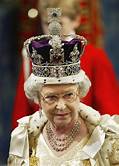
The second crown used in the coronation is called The lmperial State Crown.
This is the crown the monarch is wearing when he or she leaves the cathedral after their coronation.
lt is worn on other occasions as well, like the State Opening of Parliament Ceremony which takes place every year.
This crown was made for George lV who wanted to add some extra glamour and colour to his coronation in 1821. lt is encrusted with diamonds.
The lmperial State Crown has a blue sapphire in the top cross which is said to have been taken from the ring finger of Edward the Confessor as he lay in his shrine. His shrine is in Westminster Abbey.
There is a large ruby at the front and a large pale blue sapphire called the Stuart Sapphire at the back.
The ruby is the Black Prince’s ruby which is a semi-precious stone mined in Afghanistan, and is said to have been worn by Henry V in 1415 at the Battle of Agincourt, with a plume placed in the hole that was drilled through it.
ln the heat of battle, you need to be easily identified.
One of the most famous diamonds ever discovered called the Cullinan Diamond was mined in 1905, and sent to Britain through the post. As an uncut diamond it was the size of a person’s hand.
When a diamond like this is found, it has to be split into parts, and those parts will have their surfaces cut and polished in order to make sparkly jewels. lt is a very skilled job, and a diamond cutter will spend a very long time studying a diamond in order to decide where is best to cut into it according to its natural formation.
The person chosen to cut the Cullinan Diamond was Joseph Asscher. He had the reputation of being the best diamond cutter in the world.
After much deliberation, he cut into the diamond in 1908 – and the story goes that after he had done this, he fainted.
He had had only one chance to get it right!
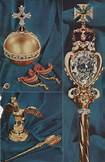
Cullinan Number One, the biggest diamond split off from the original find sits at the top of the sceptre. lt is the largest, flawless, colourless, cut diamond in the world.
The sceptre is a baton of power.
Cullinan Number Two is set at the front of the lmperial State Crown. lt is set in the circlet part of the crown – the ring that goes around a person’s head.
ln all, nine large diamonds were cut from the diamond – and several fragments.
Both crowns are heavy to wear.
The orb is a globe which is the same shape as the Earth. lt denotes earthly duty, and the cross on top of the orb is an expression of religious and moral authority.
Since the time of Henry Vlll, the monarch has been Head of the Church as well as the nation.
There is a special orb stand in the coronation coach for it to rest on when the monarch goes back to the palace after being crowned.
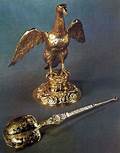
There is an ampulla and ornate spoon both made of gold. These are used in the anointing part of the ceremony which is the most holy part of all.
The ampulla is a vessel eight inches tall fashioned into the form of an eagle. The eagle is supposed to be a messenger that has flown down from God.
Cherubim angels, a high order of angels, have a face of an eagle on their head.
The recipe for the anointing oil mix dates back to the 1600s, and contains amongst other things: oils of olive, sesame, orange, rose and jasmine and also ambergris which comes from whales.
The oil used for King Charles lll’s coronation was supposed to be a secret recipe, but we do know it was made up in the Holy Land ready for his coronation on 6th May 2023.
The oil is poured from the flask into a spoon.
This spoon is the only item to survive from before the previous Crown Jewels were destroyed.
The spoon was bought by someone who presented it back to King Charles ll when he came to the throne after the Restoration of the Monarchy in 1660.
The spoon dates back to the 1100s.
The sword is encrusted with emeralds and diamonds with decorations of acorns and oak leaves. lt represents the monarch’s responsibility to defend their kingdom.
There is also a bejewelled ring called the Sovereign’s Ring which some call the Wedding Ring of England. lt has a pink cross on a blue background. The wearing of this ring symbolizes the monarch’s lifetime commitment to their people.
A new crown was made in 1911 for Queen Mary. The Queen Mary Crown was used by Queen Camilla when she was crowned in 2023.
Nowadays, the Crown Jewels are closely guarded, and kept safely behind much security.
To protect them from falling into the wrong hands during the Second World War, the Crown Jewels were hidden under Windsor Castle in small chambers built at the end of a mediaeval tunnel used for hiding in times of siege.
The most important jewels were put in a jar and hidden in a biscuit tin in case they had to be whisked away to safety yet again in an emergency.
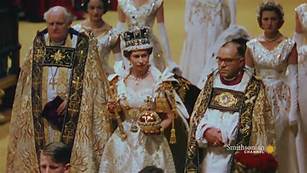
Luckily, the Crown Jewels were able to return to the Tower of London ready for the coronation of Elizabeth ll who would carry on the traditions of her predecessors. They were then passed on to her son, King Charles lll.
lf you have a pack of playing cards in your house, have a look at the court cards and see what the kings and queens in your pack are holding.
Are they holding swords, sceptres and batons?
Bye bye everyone – don’t forget to subscribe to my blog!
Love and kisses
Salty Sam

www.christina-sinclair.com

Bill and Bob’s Joke of the Week
Bill: Name two days of the week beginning with ‘T’.
Bob: Today and Tomorrow.
Salty Sam © Christina Sinclair 2015
Unauthorized use and/or duplication of material from this blog without express and written permission from this blog’s author and owner is strictly prohibited.
Links may be used to www.christina-sinclair.com
Picture Gallery
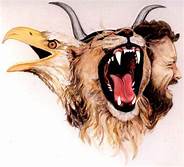
The head of a Cherubim Angel
With an eagle head at the back
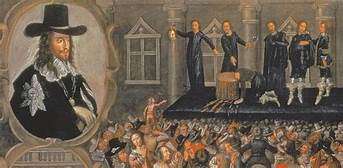
Execution of Charles I
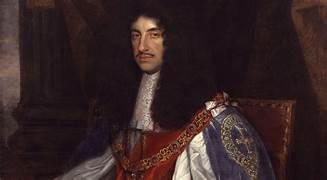
Charles II
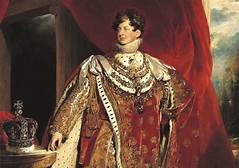
George IV
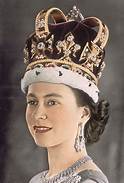
Elizabeth II
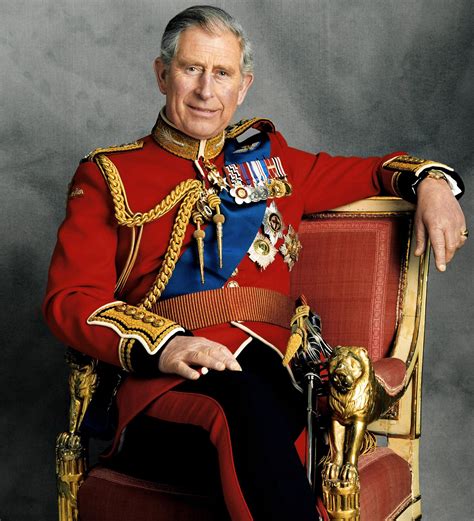
Charles lll
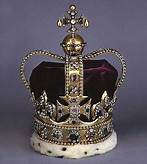
St Edward’s Crown
From Charles II
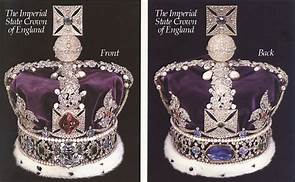
The Imperial State Crown
From George IV

 THE SALTY SAM NEWS DESK

This week, Bill and Bob’s mum had to go up to Farmer Jenkins’ farm to speak to Mrs Jenkins about some business, and took the Bill, Bob, Emily and Henry up with her for a walk.
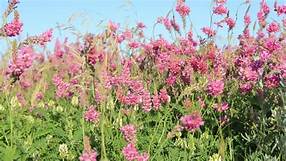
As they were passing one of the fields, they saw it was full of pink flowers.
Well, pink flowers amongst a lot of grass actually.
If you see a field full of bright yellow flowers it will probably be oil seed rape, and if you see a field full of blue flowers it will probably be flax flowers grown to make flax oil.
But the children had never seen these pink flowers before.
Farmer Jenkins was in the farmyard when they got there, and he explained to the children that the flowers were called sainfoin.
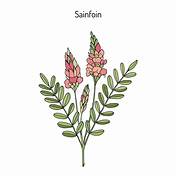
He was growing something called a herbal ley in that field.
A herbal ley is a mixture of grasses and herbs and plants called legumes – peas and beans are examples of legumes. Clover is a good herb to use.
A herbal ley helps to improve soil health because it takes nitrogen from the air and fixes it into the soil.
In addition, it fends off pests and diseases and locks carbon away in the soil.
Sainfoin has very deeps roots, and so is drought tolerant if we have a hot, dry summer.
The abundance of flowers provides more food for pollinators than a normal grass meadow, so you will see a lot of insects buzzing around between the flowers.
The crop is good at holding water in a downpour of rain, which stops soil erosion, and it is good grazing for cows.
Once the soil is rejuvenated, it is really good for growing a crop like wheat or barley.
You can keep the herbal ley in the field for a season or a few years, and then plough it into the soil, then you don’t need to use artificial fertilizer which is expensive to buy. This natural way of looking after the soil was used a lot about seventy years ago, and it is becoming popular again as people like to try and work with nature more.
Farmer Jenkins said that gardeners could use the same techniques in their vegetable patches.
In fact, that is one of the reasons they practise crop rotation because peas and beans put nitrogen into the soil.
Gardeners can grow crops of chicory, comfrey or clover and then dig it into the ground to improve their soil.

*********************
*********************
 Quick Quiz
The monarch does not have the power to make decision for the country anymore. That power has been given over to Parliament. The monarch is a symbol, a host to important people, and a unifying force during times of trouble and celebration.
Do you know what these words and phrases mean?
- charisma
- a figure of authority
- a persona
- a backstabber
- the hustings
- a constituency
- a constituent
- liberal
- a cabinet minister
- a backbencher
- a hung parliament
- a soap box


lt’s the Weekend!
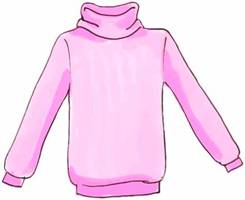
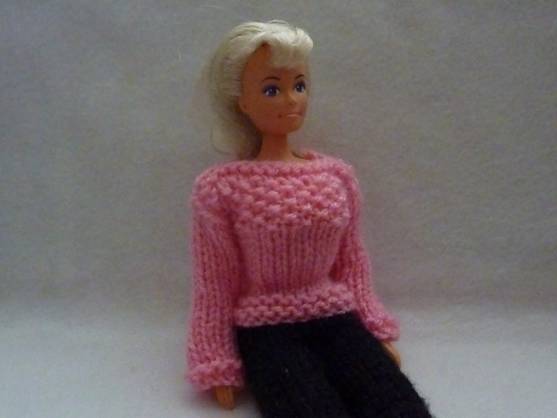
HOW TO MAKE A CROP TOP FOR A 12” DOLL
This is a cute crop top for a 12” doll.

FRONT AND BACK (KNIT TWO)
Using 4mm knitting needles and dk yarn cast on 17 stitches
Knit 4 rows of garter stitch
Knit 12 rows of stocking stitch
Slip 1 (knit 1, purl 1) rep last 2 stitches 7 times
Repeat last row 7 times
Knit 2 rows garter stitch
Cast off
SLEEVES (KNIT TWO)
Using 4mm knitting needles and dk yarn cast on 12 stitches
Knit 2 rows of garter stitch
Knit 20 rows of stocking stitch
Cast off
Please note that the material on this blog is for personal use and for use in classrooms only.
It is a copyright infringement and, therefore, illegal under international law to sell items made with these patterns.
Use of the toys and projects is at your own risk.
©Christina Sinclair Designs 2015
Quick Quiz Answers
- charisma – an aura of charm and authority that people find attractive, hence they are likely to want to follow them as a leader
- a figure of authority – someone who has power to tell other people what to do
- a persona – the personality you show publicly
- a backstabber – someone who does wrong to someone else when it seemed like they were supporting them
- the hustings – this is the name of a special meeting where people representing parties (or just themselves as an independent candidate) who are standing for election answer questions from an audience in order to talk about what policies and ideas they would represent if given power to make decisions
- a constituency – an area of land that a member of Parliament represents – he is supposed to look after the people living there and represent their rights and well-being in parliament
- a constituent – a person living in a constituency
- liberal – the idea that people should make their own choices and not be totally controlled by government or dictators
- a cabinet minister – someone who is guiding a government department according to the wishes of an elected government
- a backbencher – an elected MP who does not have a job in cabinet
- a hung parliament – when one political party does not have a good majority, the parliament is quite evenly balanced between parties and consequently a coalition government might be formed (more than one political party forms a government)
- a soap box – a box (that had transported soap to a shop from a warehouse) that someone could stand on to elevate themselves above a crowd, once they were higher than the people around them, they could start telling them their views on a subject – nowadays, when someone says they are on their soapbox they just mean that they are forcefully talking about their views on a subject of political interest