
Salty Sam’s Fun Blog for Children
Number 603
Sacred Trees of the East
Hello Everyone
lf you stood anywhere in Rocky Bay and looked around you, you would see many trees.
You would probably be able to name quite a few of them.
Well l mean tell what species they were – not if they were called Bob or Dave or something like that.
lf you were standing in the woods, you would see mostly native species, but if you were in a garden, chances are, a lot of the trees there, would have come from abroad at one point in history, as many plant hunters over time have collected exotic species to make our landscapes more interesting.
And if you went anywhere in Europe, it would probably be the same – you would recognise a lot of the trees in view like: oaks, beeches, poplars and so on.
But if you travelled further afield, this might not be the case.
There are many trees on other continents that you may have never seen here.
Some trees in other countries have really special meanings to the people who live there.
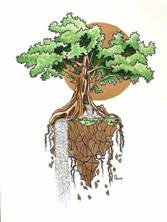
The pipal tree, also called the bo tree, bodhi tree or sacred fig is native to lndia and lndochina.
But you will now find it in other places in the world that have a similar climate like Florida, South America and the rest of tropical Asia.
ln the Middle East, they can be used as trees to line avenues, and in Thailand they have a saffron cloth wrapped around their base to denote they are sacred.
The sacred fig likes good drainage and so grows well in shallow soil and even cracks and crevices, which means it can become quite invasive, finding any little nook to grow in; it can even grow on walls and buildings!
lt was thought by Hindus for the longest time to be the sacred tree of Vishnu, who to them was the eternal divine being, or in other words a god.
lt was also the tree that Buddha sat underneath in order to find the serenity he needed to meditate. This was his way of accessing divine intelligence which he used in his mission to try and find out how to release all living creatures on Earth from suffering.
Consequently, it became known as the ‘tree of awakening’ – or in other words becoming wise.
lt is said that in the 3rd century BC, a shoot from the tree under which Buddha sat was taken to Anuradhapura in Sri Lanka where it is still living and revered. lt is the oldest, living, human-planted, flowering plant in the world.
The pipal tree has a reported lifespan of over 3,000 years.
The powdered bark is used in Ayurveda medicine (a traditional lndian health care system) to heal wounds and cure infections. But compounds from the tree are also used to treat many disorders affecting different parts of the body.
The tree can be grown as a houseplant, but prefers to be outside, and it needs a lot of watering.
The banyan is another sacred fig tree to be found in lndia where the Vedas (a large collection of religious texts) and Upanishads (writings of Hindu philosophies) associate it with Brahma, who is the Hindu immortal god of creation.
lt is the national tree of lndia and of other countries like Vietnam, Guam and the Philippines; these trees have spiritual significance in their traditional folklore.
The banyan is easily recognised because of its spectacular habit of sending aerial roots down into the soil, eventually these become additional trunks that support the ever-expanding canopy.
Eventually, and amazingly, this network of extra trunks enables a single tree to spread across several acres of land. Such an enormous canopy can provide welcome shade and shelter for large numbers of people at a time.
lt also offers shelter and food to fig wasps, which in turn, act as pollinators to create its tiny seeds.
These seeds are distributed by birds which drop them onto tree branches. There they grow and sent roots down to the forest floor.
lf the host tree eventually dies, the hollow middle of the central trunk will provide living accommodation for many types of animals.
Both the bark and leaf buds of the banyan tree are used in Ayurveda medicine to stop bleeding.
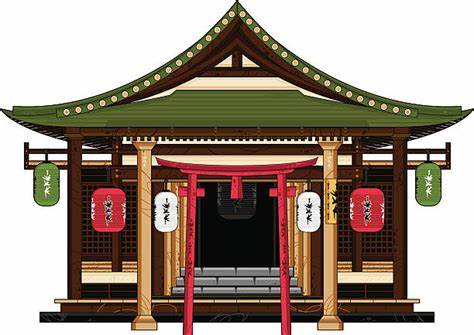
Across the sea in Japan, another tree takes a special place in religious culture.
The Japanese sugi pine is often seen growing near temples (places of worship) and shrines (places dedicated to something considered holy) because it is regarded as a sacred tree (just like yew trees are grown in church yards here because they formed sacred groves for the druids).
lt is the national tree of Japan.
lt is an evergreen conifer native to Japan and China and can grow up to 70 metres high and is conical in shape (shaped like a cone). lt can take on a blue tones in winter and new, spring shoots are yellow. lt has needles, not leaves.
Many of these trees are extremely old which makes them all the more revered and special. The sugi tree growing in the grounds of Shinto Sugawara Shrine in Yamanaka Onsen, Japan is thought to be at least 2,000 years old
And the Jömon Sugi in Yakushima is thought to be even older, and is one reason why the island has been designated a UNESCO World Heritage Site.
(The United Nations Educational, Scientific and Cultural Organization was founded in 1945. lt has labelled hundreds of places across the world as precious and, therefore, monuments that should be protected.)
Sugi wood is an unusual light-red colour and because it is resistant to deer, insects and decay, it is widely used as a building material.
lt is grown in plantations. lt is economically valuable.
The trees tolerate being near the coast, they make a lovely specimen tree in a lawn, or can be used for topiary (clipped into shapes) but they usually grow in moist forests when in the wild.
Bye bye everyone – don’t forget to subscribe to my blog!
Love and kisses
Salty Sam

www.christina-sinclair.com

Bill and Bob’s Joke of the Week
Bob: What is the point of joining the Flat Earth Society?
Bill: l’ve heard that it broadens your horizons.
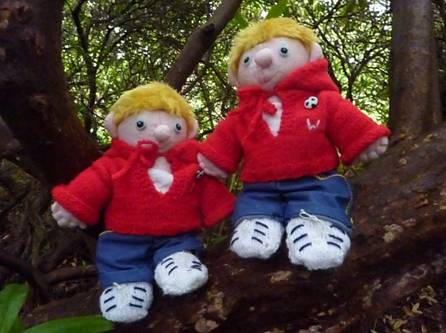
Salty Sam © Christina Sinclair 2015
Unauthorized use and/or duplication of material from this blog without express and written permission from this blog’s author and owner is strictly prohibited.
Links may be used to www.christina-sinclair.com

Picture Gallery

Pipal tree bark

Pipal leaves

Banyan tree

Japanese sugi pine

 THE SALTY SAM NEWS DESK

Earlier in the year, I told you about Emily starting her new hobby of scrapbooking.
Well, it is going very well, and she is used to looking for little pictures and design ideas to decorate her scrapbook pages.
She can use little pictures to decorate the pages around the memorabilia she collects, or she uses frames of pictures to surround them. The frames can be square, rectangular or circular.

Because of this, she had an idea of what to do with a picture she particularly liked because she felt it matched the décor in her bedroom.
You may remember it was painted pink when her family moved into Periwinkle Cottage a while back.
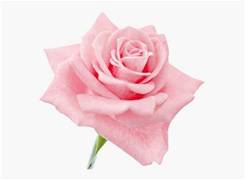
She found quite a large jar that did not have a lid and decided to turn it into a vase.
Her mum cleaned it for her by soaking the label off and then getting rid of the rest of the residue of glue by wiping it off with some nail polish remover.
Then with plenty of newspaper spread over the kitchen table and an old apron covering her dress, Emily covered the outside of jar with white, acrylic paint.
Once that was dry, she glued the picture on the front of the jar with PVA glue and importantly put glue on top of the picture too in order to seal and protect it.
The top of the jar would be covered with flowers so didn’t look like a jar anymore.
It just looked like a pretty vase.


*********************
*********************
 Quick Quiz
Do you know what these words and sayings mean?
- to draw to a close
- to draw a veil over
- to pay lip service
- to take a shine to
- to do something by the book
- to hang over one’s head
- to take a shine to
- the clock is ticking
- a breath of fresh air

lt’s the Weekend!

HOW TO MAKE A LlTTLE BOOK OF lNSPlRATlON
You will need to find a few pieces of paper or thin card and cut them the same size to make a mini book.
The book needs to be small enough for you to reach into the centre with the stapler you have, but big enough for you to be able to write a few words on each page.
If you want to write across two pages and you want to write on the paper or card before you assemble your little book, be very careful where you write – you need to check that everything will match up when the book is put together.
Then find a few phrases of inspiration to write in your book.
Reading these phrases can spur you on when you find life to be tough going sometimes.
What will you need to tell yourself at times like these?

Here are some to start you off…
Every morning is a new start to a wise man
Little things don’t bother big people
Don’t give up; you may be nearer than you think
The harder I work, the luckier I get


Please note that the material on this blog is for personal use and for use in classrooms only.
It is a copyright infringement and, therefore, illegal under international law to sell items made with these patterns.
Use of the toys and projects is at your own risk.
©Christina Sinclair Designs 2015
Quick Quiz Answers
- to draw to a close – to come to an end
- to draw a veil over – to cover up something and move forward – it is too unpleasant to talk about anymore
- to pay lip service – to say something to someone that they want to hear even though you don’t believe what you are saying – to show respect and loyalty that you don’t really mean
- to take a shine to – to really like something or someone
- to do something by the book – to follow the rules
- to hang over one’s head – a problem that is yet to be resolved
- the clock is ticking – you have a deadline to work to and time is running out
- a breath of fresh air – something new that is very welcome
- an epoch – a duration of time – an age – a period of history